Mandate
How an owner writes, simulates and signs versioned spending rules with a passkey, and how one deterministic policy engine applies them to every payment.
The problem it removes
A spending limit written into a prompt is a suggestion. The agent can misread it, and a page it reads can talk it out of it. Abazi Mandate moves the limits out of the agent's reach: into a document a person signs, which the agent can neither see nor edit, enforced by a fixed function that returns the same decision and reason code for the same input.
Who uses it
| Who | How |
|---|---|
| Owners and admins | Write a draft, simulate purchases against it, review the changes and sign it with a passkey. |
| Finance | Read every version and its limits, without the right to sign. |
| Agents | Never see or edit it. They get a decision and a reason code back. |
How it works
- Draft. The owner sets limits, allowed rails and networks, categories, merchant tiers and an expiry. Every edit creates a new draft version; signed versions never change.
- Simulate. The editor runs a sample purchase through the same policy engine, without reserving anything, and shows the decision and reason code.
- Sign. The owner reviews the difference from the active version and signs with a passkey. Abazi issues the mandate in AP2 v0.2 format (an SD-JWT that Abazi builds and verifies itself).
- Activate. The signed version becomes active and the previous one is superseded. Decisions already made keep the version they were made under.
- Enforce. On every payment the policy engine walks a fixed evaluation order and stops at the first step that applies, returning ALLOW, REQUIRE APPROVAL or DENY with a reason code and a step-by-step trace. See Mandates and policy.
Limits in the example mandate
| Limit | Example value |
|---|---|
| Auto-approve limit | 0.10 USDC |
| Hard cap per purchase | 0.50 USDC |
| Plan hard cap | 1.50 USDC |
| Unknown-merchant limit | 0.10 USDC |
| Card hard cap per authorization | 25.00 USD |
| Card auto-approve limit | 5.00 USD |
A draft is refused if an auto-approve limit or the unknown-merchant limit is above its hard cap, if it allows no rail, or if its expiry is more than 90 days ahead.
Screens
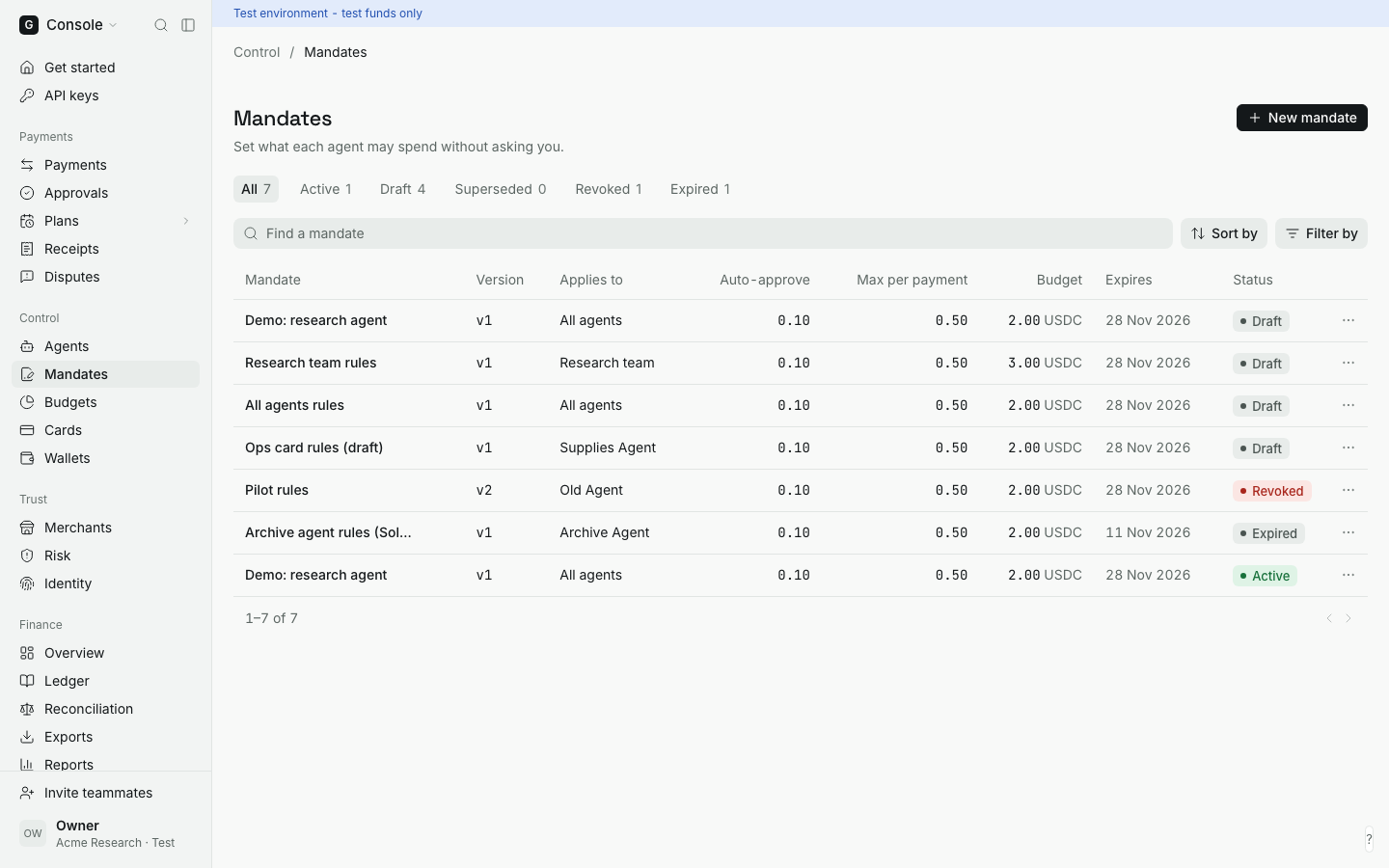
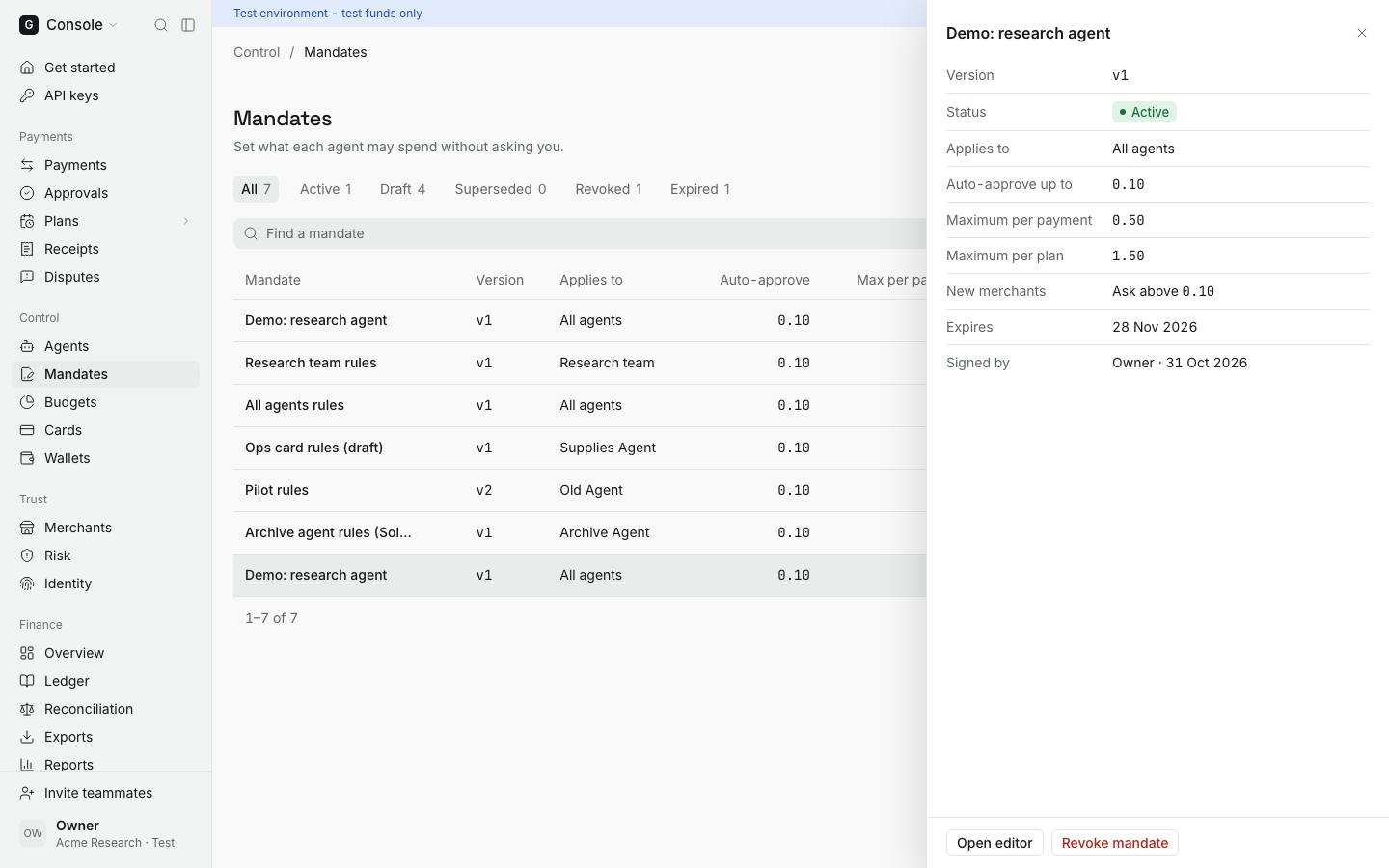
Boundaries
| Case | What happens |
|---|---|
| A purchase above the auto-approve limit | REQUIRE APPROVAL with ABOVE_AUTO_THRESHOLD; a person decides. |
| A purchase above the hard cap | DENY with HARD_CAP_EXCEEDED. An approval cannot raise a hard cap or a budget. |
| The mandate has expired or was revoked | DENY with MANDATE_EXPIRED or MANDATE_REVOKED. |
| The agent asks for a rail the mandate does not allow | DENY with RAIL_NOT_ALLOWED. |
The agent's stated purpose is kept for the audit trail. It is never an input to the decision, except that Shield scans it for prompt injection.
API
The Mandates operations in the API reference, each with its parameters, responses and code samples:
- GETList mandates
/v1/mandates - POSTCreate mandate
/v1/mandates - GETGet mandate template
/v1/mandates/template - GETGet mandate
/v1/mandates/{id} - POSTCreate mandate version
/v1/mandates/{id}/versions - GETGet mandate version
/v1/mandates/{id}/versions/{version} - GETCompare mandate versions
/v1/mandates/{id}/diff - POSTGet mandate signing options
/v1/mandates/{id}/versions/{version}/sign/options
Next steps
Gateway
Abazi Gateway, the payments gateway. One agent request becomes one policy decision, one reservation, one signed payment on the right rail and one receipt.
Budget
How limits at organization, team and agent level are reserved in one transaction, so agents running in parallel cannot overspend a shared limit.