Accept
How a merchant turns an HTTP endpoint into one any x402 client can pay, with requirements taken from the Catalog and delivery reported back.
The problem it removes
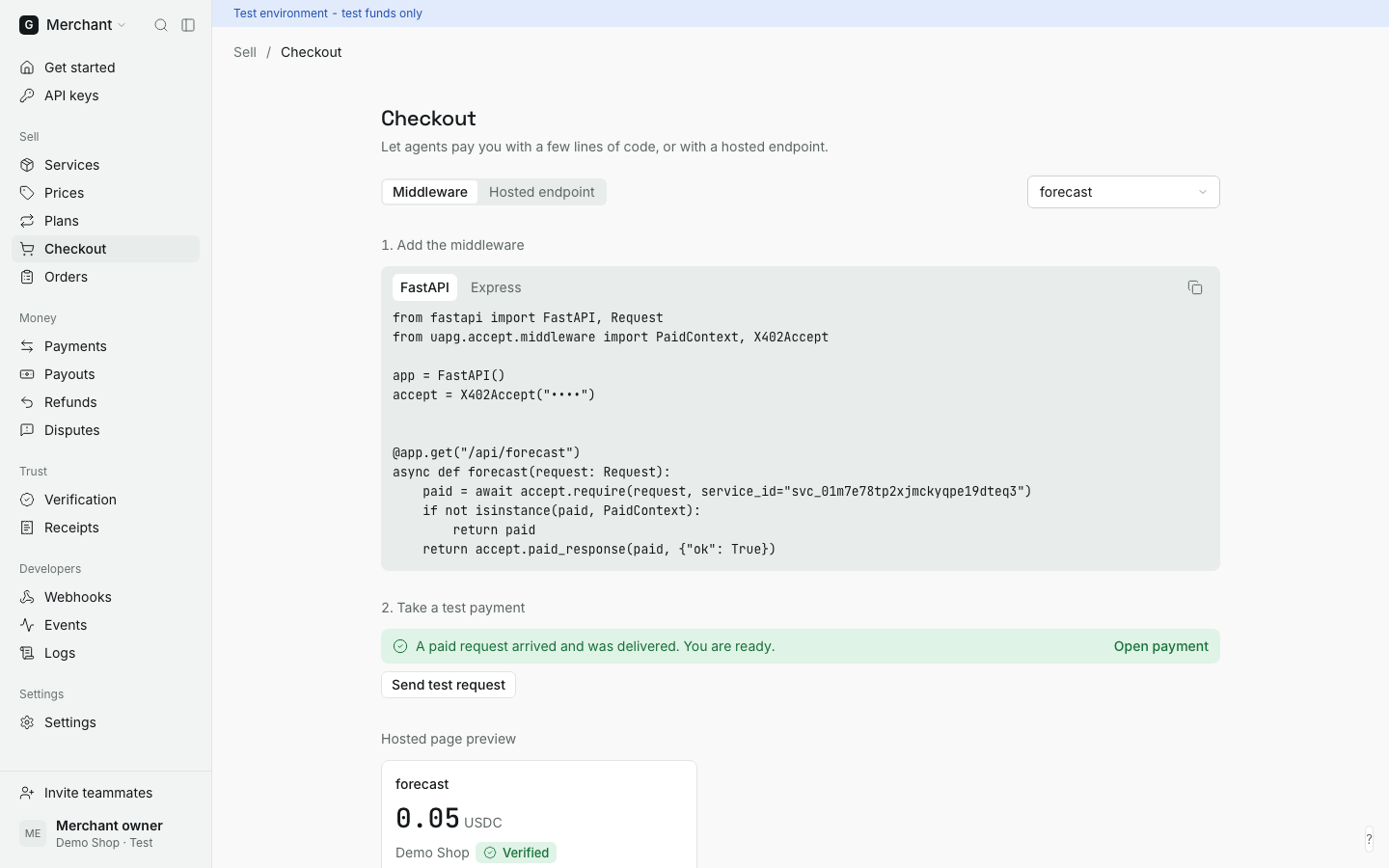
An agent can only pay what a merchant asks for in a form it can read. Without a standard answer, every merchant invents its own checkout and every agent needs custom code for each one. Abazi Accept gives the merchant that standard answer: an x402 (version 2, exact scheme) 402 response listing the price, asset, networks and payout address. Any x402 client can pay it, whether or not the merchant ever registered with Abazi.
Who uses it
| Who | How |
|---|---|
| Merchant developers | Wrap a route with the Accept middleware, or point Abazi's hosted endpoint at an existing service with no code. |
| Merchants | List services and prices, and see payments, deliveries and payouts in the Merchant area. |
| Agents | Call the endpoint, read the 402, and let Abazi pay and retry with the payment attached. |
How it works
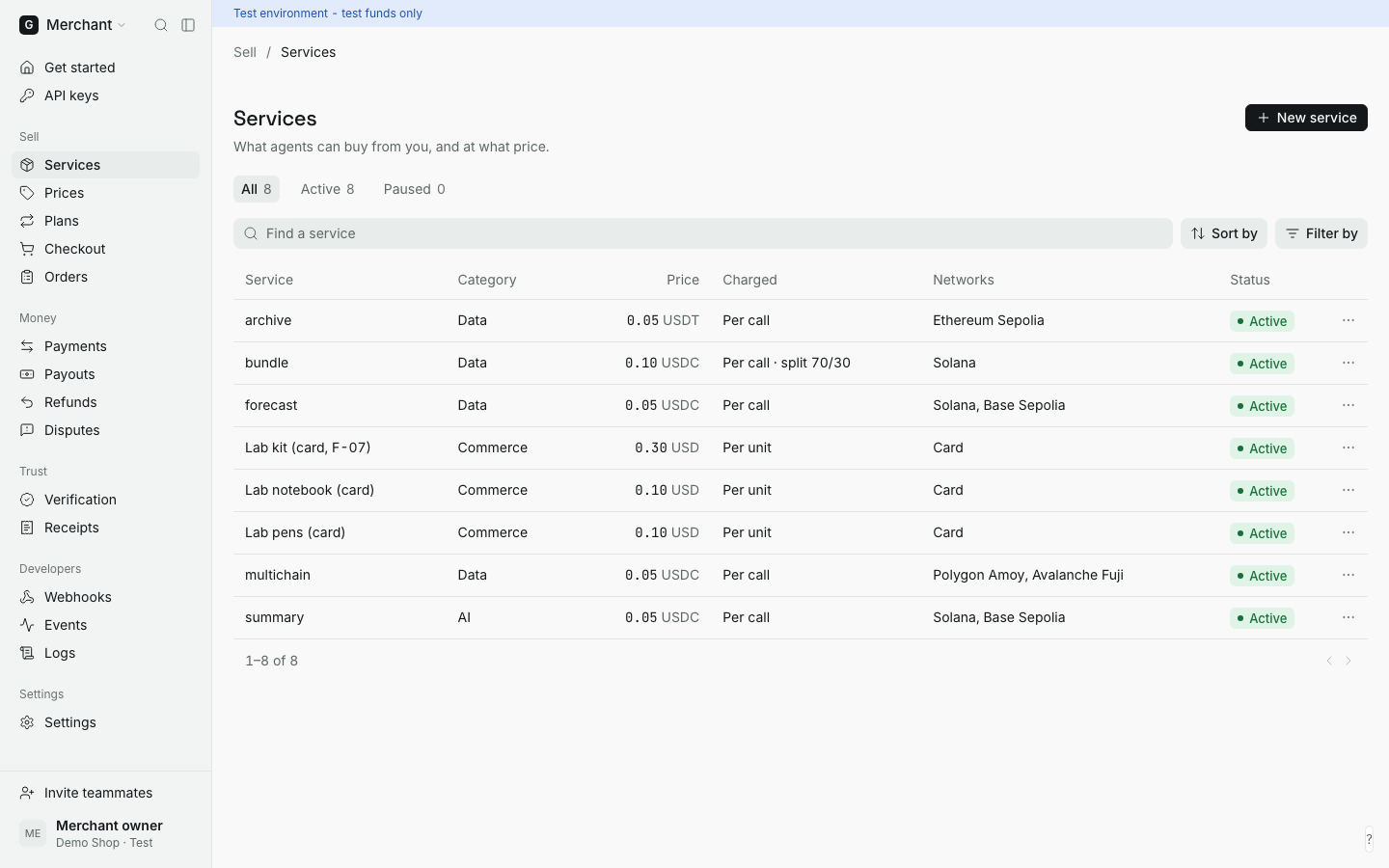
- List the service. Price, asset, accepted networks, a payout address per network and the URL go into the Catalog.
- Unpaid request, 402 response. The middleware answers with payment requirements built from that listing, so what the agent reads is exactly what Abazi checks against.
- Paid retry. With a payment attached, the middleware verifies and settles it through an x402 facilitator, moving to the next one where two cover the network, and returns the resource.
- Direct USDT. For USDT on Ethereum and Tron, the 402 also lists a direct-transfer option. The merchant releases the resource once Abazi confirms the transfer reached its payout address.
- Delivery report. After each paid request the middleware reports the request as delivered or failed, so owners can tell paid from delivered.
The middleware talks to Abazi and the facilitators over HTTP only. It never reads Abazi's database, so a merchant can run it beside its own service.
Merchant tier
A merchant that never registered starts in the UNKNOWN tier. Buyers' mandates cap purchases there at the unknown-merchant limit (0.10 USDC in the example mandate); above it, a person must approve. Payments from several organizations can raise a merchant to KNOWN, and signatures plus an on-chain attestation raise it to VERIFIED. A change of payout address or domain resets it to UNKNOWN. See Merchant trust tiers.
Screens
Boundaries
| Case | What happens |
|---|---|
| The live 402 names a different payout address than the Catalog | The buyer's purchase is denied with PAYTO_MISMATCH. |
| The live 402 asks a different price than the listing | Denied with AMOUNT_MISMATCH. |
| The live 402 offers a network the listing does not | Denied with NETWORK_MISMATCH. |
| The delivery report fails to send | It is logged; the payment is not undone. The buyer can still open a dispute. |
Abazi Accept supports the x402 exact scheme, plus the direct USDT option, on the networks listed in Supported rails.
API
The Merchants operations in the API reference, each with its parameters, responses and code samples:
- GETGet merchant home
/v1/merchant - PATCHUpdate merchant profile
/v1/merchant - GETList merchant services
/v1/merchant/services - POSTCreate merchant service
/v1/merchant/services - PATCHUpdate merchant service
/v1/merchant/services/{id} - DELArchive merchant service
/v1/merchant/services/{id} - GETList merchant payments
/v1/merchant/payments - GETGet accept setup
/v1/merchant/accept
Next steps
Billing
How installments and subscriptions run on Solana, approved once for their full terms and pulled on schedule through an on-chain subscription program with a cap per period.
Catalog
How the Catalog holds every service's price, networks and payout address, lets agents search it, discovers new merchants from a 402 response, and checks every purchase against the listing.