Proof
How every payment gets a signed, hash-chained receipt anchored on Solana, and how anyone can run the four checks without an account.
The problem it removes
A payment history kept only in the payment provider's database is only as trustworthy as that database. Abazi Proof makes each record checkable from outside: change one character and the hash fails, remove a receipt and the chain breaks, and the anchor on Solana fixes the hash in time where Abazi cannot rewrite it.
Who uses it
| Who | How |
|---|---|
| Owners and finance | Open any payment's receipt, with its hash, signature, chain position and anchor. |
| Auditors and counterparties | Run the four checks on the public verify page, without an account. |
| Developers | Fetch the public signing keys and verify receipts in their own code. |
How it works
- Build. On confirmation Abazi writes the receipt body: what was bought, from whom, under which mandate version, the decision, the approver if any, amount, asset, network, rail, payee and settlement reference.
- Canonicalize and hash. The body is serialized as canonical JSON (RFC 8785) and hashed with SHA-256.
- Sign. The hash is signed with Ed25519. The public keys are published at
/.well-known/uapg-receipt-keys.json, each with its key id. - Chain. Each organization has one chain: every receipt carries a sequence number and the previous receipt's hash. The first one points at 64 zeros.
- Anchor. The hash is written to Solana in a memo transaction,
uapg:v1:followed by the hash. The anchor is pending until that transaction is finalized.
Receipts exist for payments, refunds, installments, sweeps and revocations. A refund receipt links to the payment it reverses.
The four checks
| Check | Passes when |
|---|---|
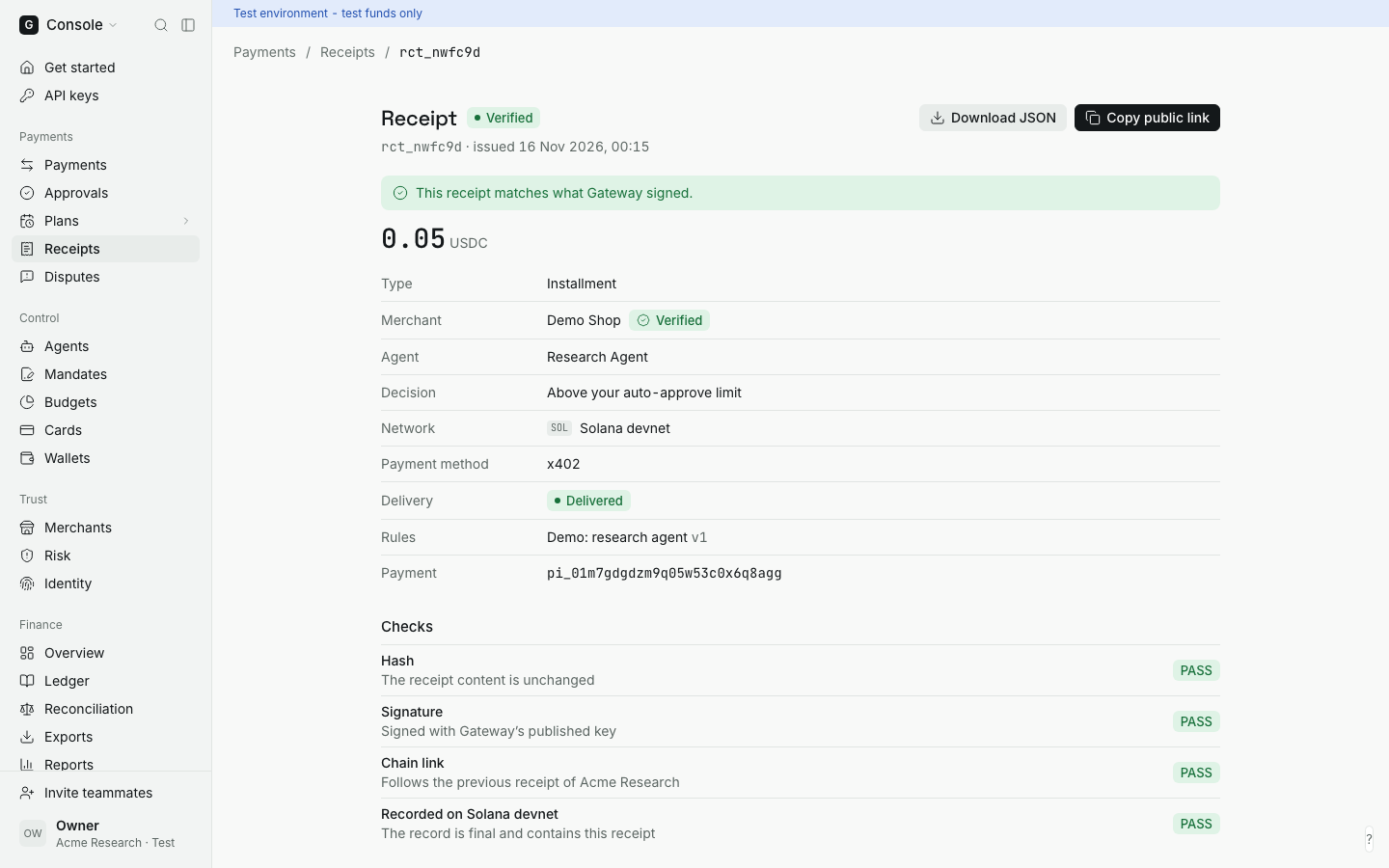
| Hash | The SHA-256 of the canonical body equals the stated hash. |
| Signature | The Ed25519 signature verifies over the recomputed hash, against the published key with that key id. |
| Chain link | The previous-hash field equals the hash of the organization's previous receipt. |
| On-chain anchor | The memo transaction is finalized and carries this receipt's hash. Until then it reads PENDING. |
The public receipt leaves out the agent's stated purpose. See Receipts and proof for the full format.
Screens

Boundaries
| Case | What happens |
|---|---|
| One character of the body was changed | Hash, Signature and Anchor fail: the signature and the on-chain memo are checked against the recomputed hash. Chain link still passes. |
| The key id is unknown or the signature was replaced | Signature fails. |
| A receipt was removed or reordered | Chain link fails. |
| The memo is not final yet | Anchor reads PENDING; check again later. |
Receipts are append-only. Anchor status is stored beside the receipt, never written into it. Proof records payments; it never decides them.
API
The Receipts operations in the API reference, each with its parameters, responses and code samples:
- GETList receipts
/v1/receipts - GETGet receipt
/v1/receipts/{id} - GETVerify receipt
/v1/receipts/{id}/verify - POSTVerify receipt document
/v1/receipts/verify
Next steps
Connect
How a platform creates accounts for its consumers, collects their consent on a hosted page, and splits each confirmed payment between the parties.
Shield
How Shield screens every purchase with versioned block and review rules and a local prompt-injection classifier, and why it only flags while the policy engine decides.