Gateway
Abazi Gateway, the payments gateway. One agent request becomes one policy decision, one reservation, one signed payment on the right rail and one receipt.
Abazi Gateway is the payments gateway at the center of Abazi: the world's first unified agentic payments gateway. Cards, stablecoins and on-chain proof run under one mandate, one policy engine and one API.
The problem it removes
An agent that can pay on its own usually needs a wallet key or a card number, and then it can spend whatever that credential allows. Abazi Gateway removes the credential from the agent. The agent holds only an Abazi credential and calls one tool; none of its tools signs, moves funds or changes rules.
Who uses it
| Who | How |
|---|---|
| Agents | Call request_purchase over MCP, or create a payment intent over REST, with an Abazi credential. |
| Agent developers | Handle the result: a receipt, a pending approval, or a denial with a reason code and a next action. |
| Owners | See every intent in the Console with its decision trace, rail, network and receipt. |
How it works
- Intent. The agent names a service from the Catalog, or a URL that answers with a 402 response, plus an idempotency key. Repeating the same key returns the same intent; a different body under the same key is refused.
- Quote. Abazi prices the purchase from the Catalog or from the merchant's live 402 response, never from a number the agent supplies.
- Decision. Abazi Shield screens the text and the merchant, and the policy engine returns ALLOW, REQUIRE APPROVAL or DENY with a reason code. See Mandates and policy.
- Reservation. On ALLOW, the amount is reserved at organization, team and agent level in one transaction.
- Signing. A durable workflow hands the payment to Abazi's signer, which rechecks the pause switch, the mandate, the reservation and the purchase fingerprint before it signs.
- Settlement. The rail pays the merchant on chain or through the card issuer, and Abazi waits for confirmation. If the outcome is unknown, the money stays reserved and the payment goes to reconciliation instead of being retried blindly.
- Receipt. On confirmation the reservation commits, the ledger posts, and a signed, hash-chained receipt is issued and anchored on Solana.
Payment lifecycle
What happens between a request and a receipt, including denials and approvals?
- Request
- Quote
- Decision
- Reservation
- Signing
- Submitted
- Settled
- Receipt
Request · step 1 of 8
The agent calls one tool with what it wants and an idempotency key. Abazi creates one payment intent.
Payment state
- current state: created
- awaiting_approval
- reserved
- signing
- submitted
- reconciling
- confirmed
- failed
- denied
- refunded
Path: created
Text description
A payment moves through eight stages: request, quote, decision, reservation, signing, submitted, settled and receipt. Its recorded state follows the payment state machine: created, then awaiting_approval or reserved or denied, then signing, submitted, and confirmed or failed; an unclear outcome goes to reconciling until the network answers.
Allowed
- Request (state created): The agent calls one tool with what it wants and an idempotency key. Abazi creates one payment intent.
- Quote: Abazi quotes the price and payout address from the Catalog, never from the agent, and Shield screens the purchase.
- Decision: The policy engine runs its fixed order. Nothing hits, so the decision is ALLOW. Reason code WITHIN_POLICY.
- Reservation (state reserved): The amount is reserved at organization, team and agent level in one transaction.
- Signing (state signing): The signer rechecks the pause switch, the mandate, the held reservation and the purchase fingerprint, then signs once.
- Submitted (state submitted): The rail adapter sends the payment. Abazi records the settlement reference and polls the network.
- Settled (state confirmed): The network confirms. The reservation is committed and the double-entry ledger posts.
- Receipt: A signed, hash-chained receipt is issued and its hash is anchored on Solana. Anyone with the link can verify it.
Needs approval
- Request (state created): The agent calls one tool with what it wants and an idempotency key. Abazi creates one payment intent.
- Quote: Abazi quotes the price and payout address from the Catalog, never from the agent, and Shield screens the purchase.
- Decision (state awaiting_approval): The amount is above the auto-approve limit, so the decision is REQUIRE APPROVAL. Approvers get a one-time link; nothing is reserved yet. Reason code ABOVE_AUTO_THRESHOLD.
- Decision: An approver approves with a passkey before the link expires (10 minutes). The policy runs again: the approval clears steps 5 to 7 only, every deny step still runs. Reason code WITHIN_POLICY.
- Reservation (state reserved): Only now is the amount reserved at organization, team and agent level.
- Signing (state signing): The signer rechecks the pause switch, the mandate, the held reservation and the purchase fingerprint, then signs once.
- Submitted (state submitted): The rail adapter sends the payment. Abazi records the settlement reference and polls the network.
- Settled (state confirmed): The network confirms. The reservation is committed and the double-entry ledger posts.
- Receipt: A signed, hash-chained receipt is issued and its hash is anchored on Solana. Anyone with the link can verify it.
Denied
- Request (state created): The agent calls one tool with what it wants and an idempotency key. Abazi creates one payment intent.
- Quote: Abazi quotes the price and payout address from the Catalog, never from the agent, and Shield screens the purchase.
- Decision (state denied): The amount is above the per-purchase hard cap. The decision is DENY with a reason code the agent can act on. Reason code HARD_CAP_EXCEEDED.
- Decision: Nothing is reserved and nothing is signed. The decision and its step-by-step trace are stored; the agent receives the code, the message and the next action.
Unknown outcome
- Request (state created): The agent calls one tool with what it wants and an idempotency key. Abazi creates one payment intent.
- Quote: Abazi quotes the price and payout address from the Catalog, never from the agent, and Shield screens the purchase.
- Decision: The policy engine allows the purchase. Reason code WITHIN_POLICY.
- Reservation (state reserved): The amount is reserved at all three levels.
- Signing (state signing): The signer rechecks the pause switch, the mandate, the held reservation and the purchase fingerprint, then signs once.
- Submitted (state reconciling): The send times out after the payment may have left. Abazi never signs twice: the intent moves to reconciling and the funds stay held.
- Settled (state confirmed): Reconciliation reads the network. Here the payment did land, so the intent is confirmed, the reservation committed and the ledger posted. Had it not landed, the intent would fail and the reservation would be released.
- Receipt: A signed, hash-chained receipt is issued and its hash is anchored on Solana. Anyone with the link can verify it.
Rails it pays on
The same intent pays over stablecoins on x402, direct USDT transfers through Tether WDK, or a per-agent virtual card:
| Rail | Solana | Base | Polygon | Avalanche | Ethereum | Tron | Card networks |
|---|---|---|---|---|---|---|---|
| Stablecoins over x402 x402 v2, exact scheme | USDC | USDC | USDC | USDC | · | · | · |
| Direct USDT Direct transfer, Tether WDK | · | · | · | · | USDT | USDT | · |
| Virtual cards Card issuing with real-time authorization decisions | · | · | · | · | · | · | USD |
Abazi picks the first network in its order that the mandate allows and that has funds; if none has, the purchase is denied with NO_FUNDED_CHAIN. See Supported rails and Rails and networks.
Screens
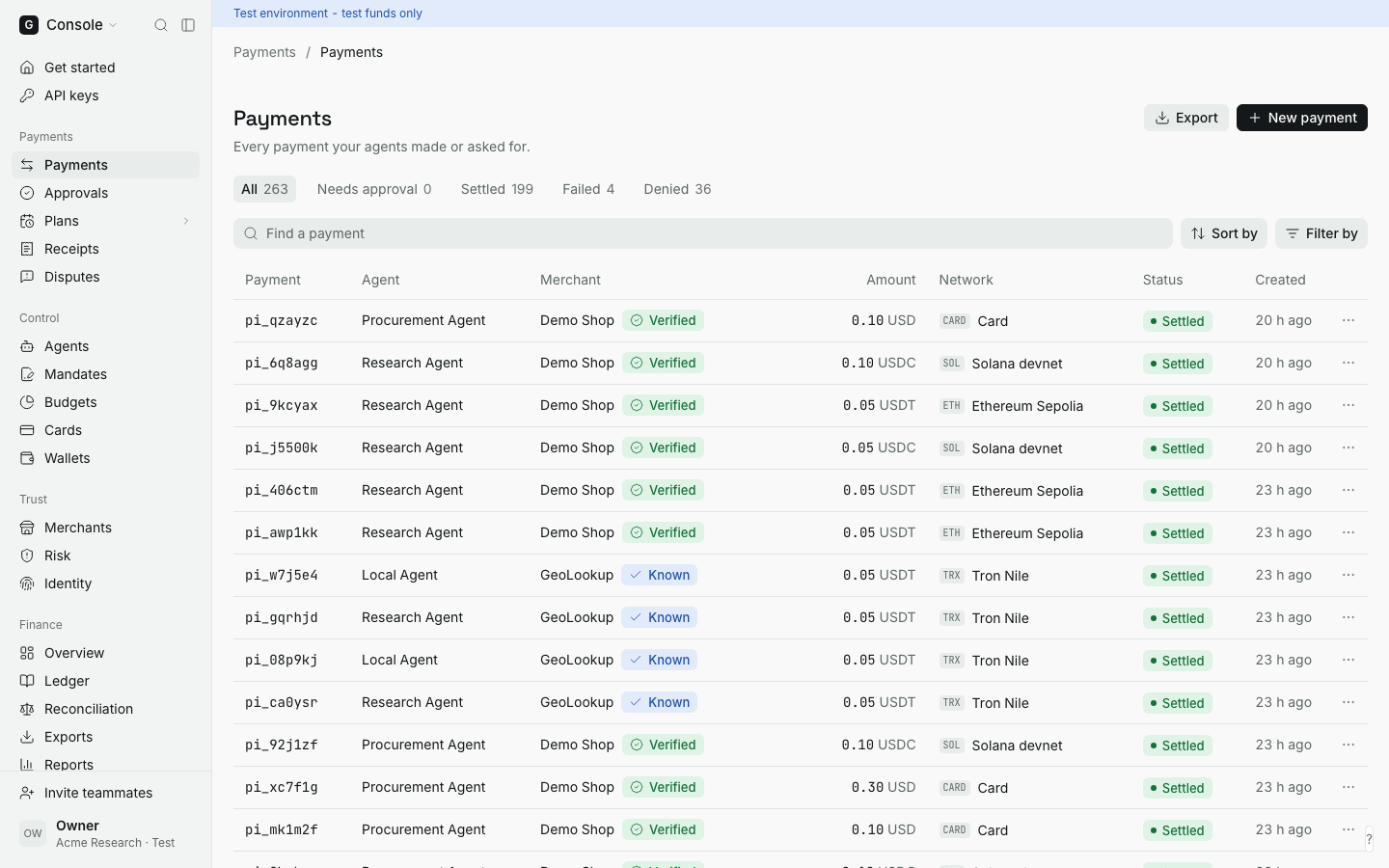
Boundaries
- Abazi Gateway never pays a price or an address that differs from the Catalog listing: a mismatch is denied at step 2.
- A purchase that needs approval does not reserve or sign anything until a person approves.
- An agent credential can request a purchase; it cannot sign, move funds or change a rule.
API
The Payment intents operations in the API reference, each with its parameters, responses and code samples:
- GETList payment intents
/v1/payment-intents - POSTCreate payment intent
/v1/payment-intents - POSTExecute payment intent
/v1/payment-intents/{intent_id}/execute - GETGet payment intent
/v1/payment-intents/{intent_id} - GETGet payment intent timeline
/v1/payment-intents/{intent_id}/timeline - GETGet spending status
/v1/spending - POSTRun sandbox purchase
/v1/sandbox/purchases - POSTReport delivery
/v1/deliveries
Next steps
Products
The Abazi product family. Abazi is the platform, Abazi Gateway is the payments gateway, and every other product does one job around the same payment core.
Mandate
How an owner writes, simulates and signs versioned spending rules with a passkey, and how one deterministic policy engine applies them to every payment.