Developer Platform
Abazi Developer Platform, the tools for integrating on both sides. API keys, signed webhooks with retries and replay, request logs, the MCP server, the REST API, the Python SDK and a TypeScript client typed from the OpenAPI contract.
The problem it removes
An integration that cannot be inspected is debugged by guesswork. Abazi Developer Platform gives agent and merchant developers what they need to integrate and debug on their own: keys they control, events they can trust and replay, and a record of what each call did.
Who uses it
| Who | How |
|---|---|
| Agent developers | Connect an agent over MCP, JSON-RPC, REST or an SDK with its Abazi credential, and read the request log when something fails. |
| Merchant and platform developers | Create API keys, register webhook endpoints and react to payment, delivery, dispute and payout events. |
| Owners | Decide who may manage keys and endpoints. |
How it works
| Tool | What it does |
|---|---|
| API keys | Secrets shown once and stored only as a hash. Creating, rolling or revoking a key needs a fresh passkey check, and a key can only carry scopes its creator holds. Rolling keeps the old key valid for an overlap you choose. |
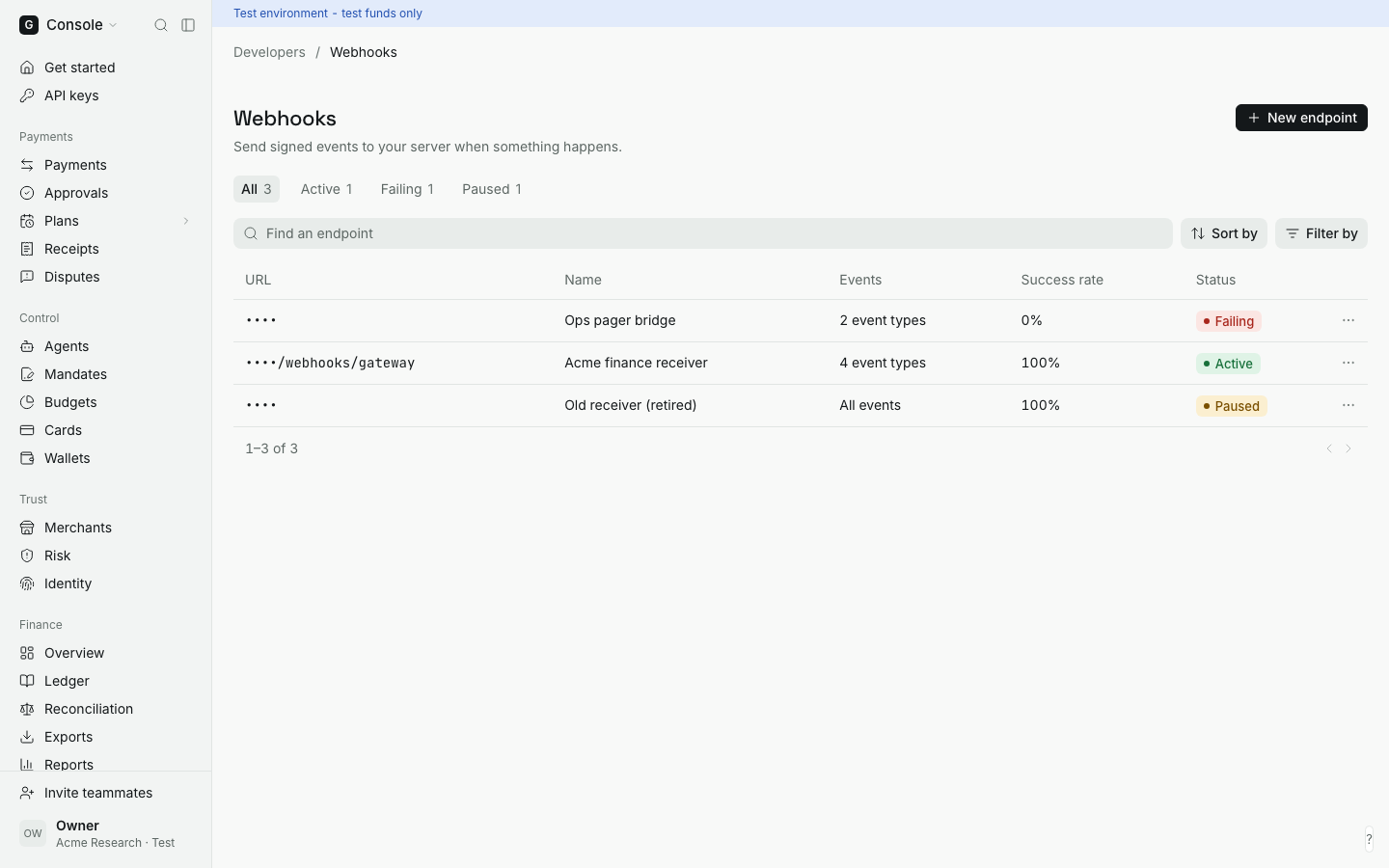
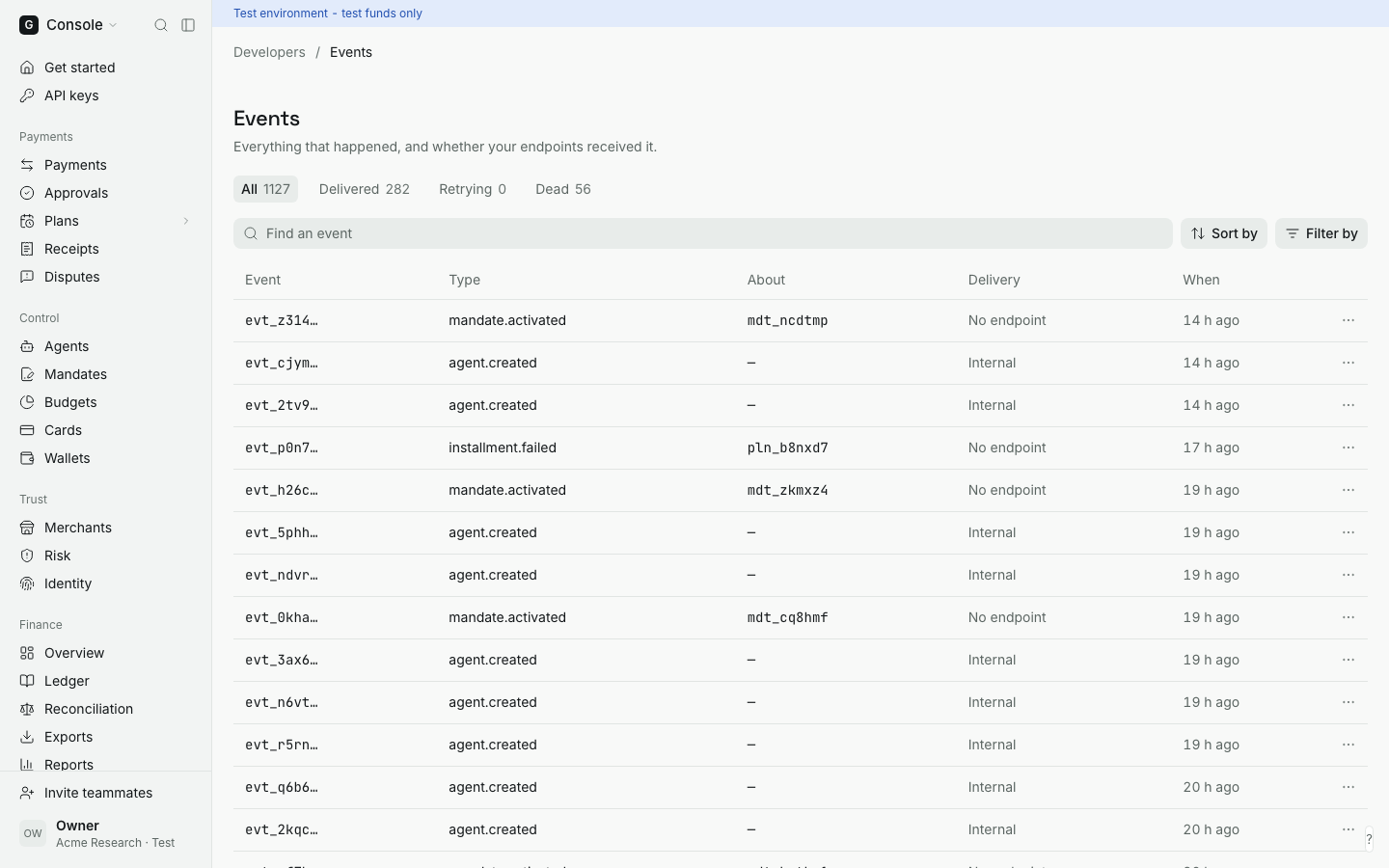
| Webhooks | Events are written in the same transaction as the change they describe, then delivered to matching endpoints signed with the Standard Webhooks scheme (an HMAC-SHA256 signature over the id, timestamp and body). |
| Retries and replay | A failed delivery is retried on a fixed schedule, up to eight attempts in all over about a day. After three failures in a row the endpoint shows as failing. Any event can be replayed to one endpoint or to all. |
| Request logs | API and MCP calls are kept for 7 days, with method, path, status, latency and the reason code if a purchase was refused. |
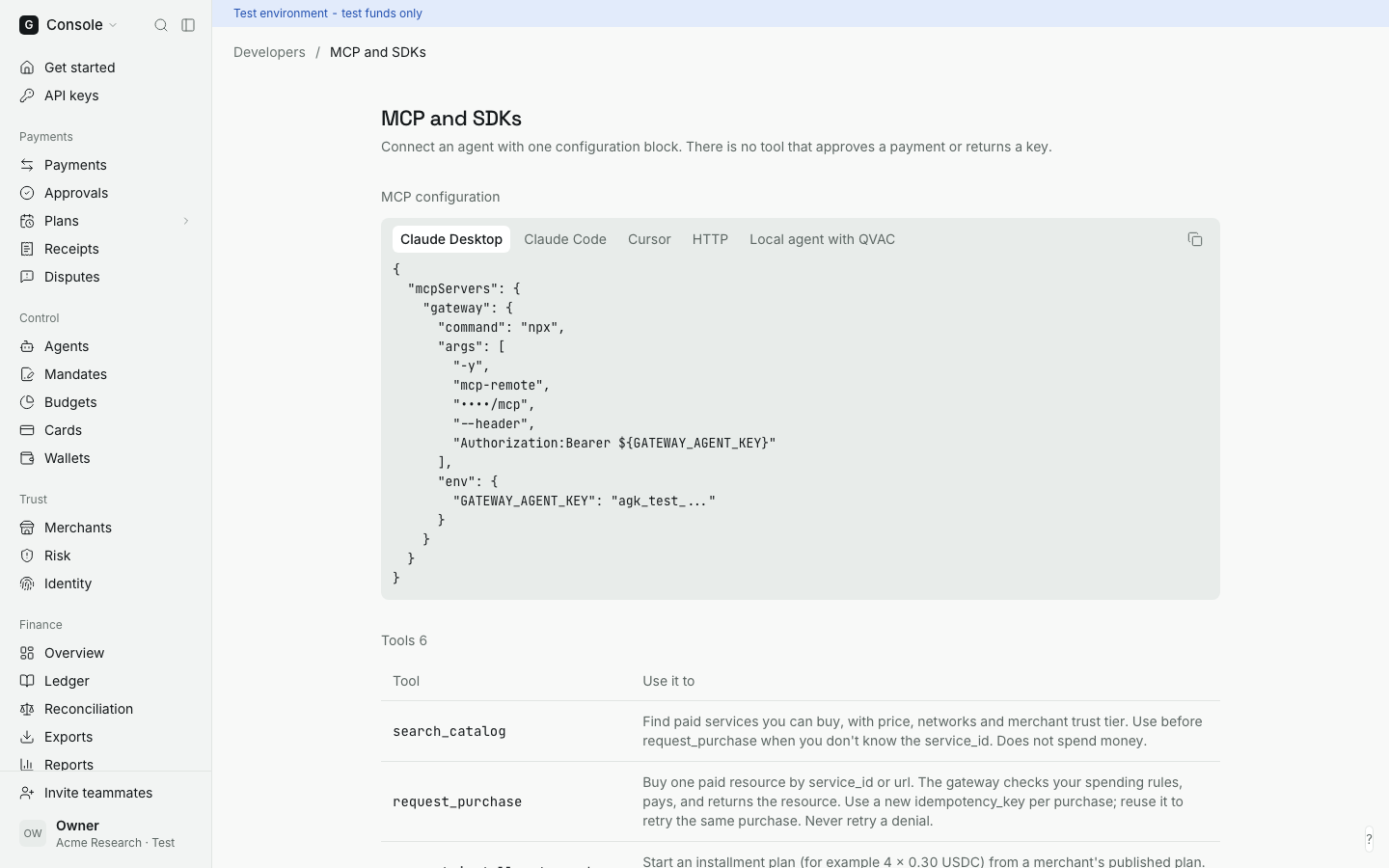
| MCP server | Six tools for agents, over stdio or streamable HTTP, authenticated with the agent's Abazi credential. |
| REST API | The same operations over HTTP, with an agent credential, an API key or a console session. |
| Python SDK | The Python SDK (uapg_client) wraps the REST API for agents. See Python SDK. |
| TypeScript | A typed client generated from the OpenAPI contract. See TypeScript. |
A webhook endpoint's address is checked before Abazi will call it, and its signing secret is shown once. Each delivery records the status code, latency and the start of the response body.
Connect an agent
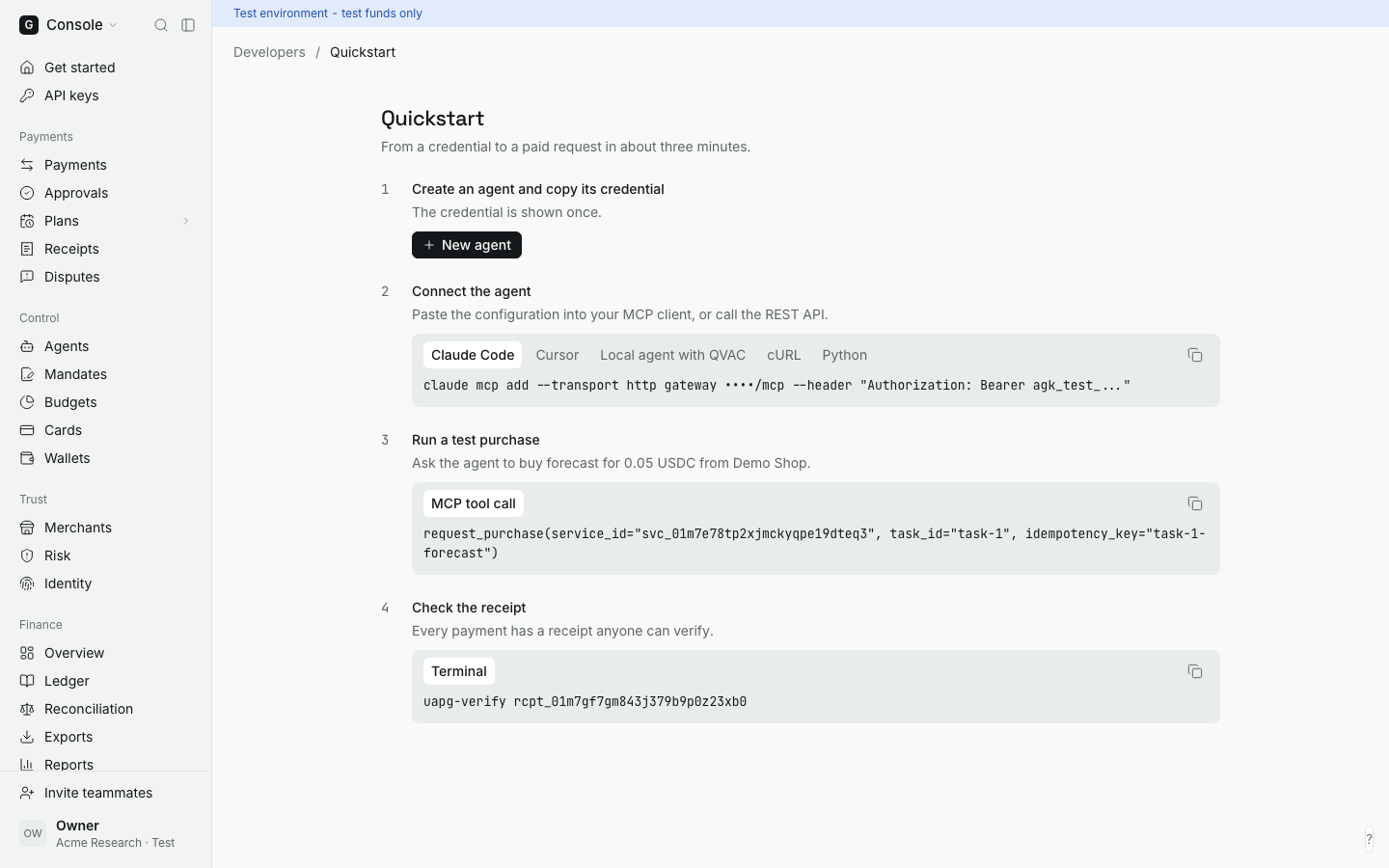
Every agent harness connects the same way: an Abazi credential and the MCP server or the REST API. Abazi supports 9 harnesses, each with its own setup page under Agents: Claude Code, Claude Desktop, Cursor, any MCP client, the Python SDK, plain HTTP, TypeScript and a local model on Tether QVAC.
| Harness | Kind | Transport | Connect |
|---|---|---|---|
| Claude Code | MCP client | Streamable HTTP | claude mcp add --transport http abazi https://api.52-28-238-205.sslip.io/mcp --header "Authorization: Bearer $ABAZI_AGENT_KEY" |
| Claude Desktop | MCP client | mcp-remote bridge | "command": "npx", "args": ["-y", "mcp-remote", "https://api.52-28-238-205.sslip.io/mcp", "--header", "Authorization:Bearer ${ABAZI_AGENT_KEY}"] |
| Cursor | MCP client | Streamable HTTP | "abazi": { "url": "https://api.52-28-238-205.sslip.io/mcp", "headers": { "Authorization": "Bearer YOUR_AGENT_KEY" } } |
| Any MCP client | MCP client | Streamable HTTP or stdio | POST https://api.52-28-238-205.sslip.io/mcp Authorization: Bearer YOUR_AGENT_KEY {"method":"tools/list"} |
| JSON-RPC | API | JSON-RPC 2.0 over HTTP | POST https://api.52-28-238-205.sslip.io/mcp {"jsonrpc":"2.0","id":1,"method":"tools/call","params":{"name":"get_spending_status","arguments":{}}} |
| Python SDK | SDK | REST | gw = Gateway("YOUR_AGENT_KEY", base_url="https://api.52-28-238-205.sslip.io"); gw.purchase(service_id=svc["service_id"], task_id="task-42", idempotency_key="task-42-step-1") |
| Plain HTTP | API | REST + OpenAPI | POST https://api.52-28-238-205.sslip.io/v1/payment-intents Authorization: Bearer YOUR_AGENT_KEY Idempotency-Key: task-42 |
| TypeScript | SDK | REST, typed from OpenAPI | createClient<paths>({ baseUrl: "https://api.52-28-238-205.sslip.io", headers: { Authorization: `Bearer ${process.env.ABAZI_AGENT_KEY}` } }) |
| Local model on Tether QVAC | Reference agent | MCP, model on device | npx qvac serve --openai → the local model picks Abazi tools; Abazi holds the keys |
from uapg_client import Gateway

gw = Gateway("YOUR_AGENT_KEY", base_url="https://api.52-28-238-205.sslip.io")
svc = gw.search("weather")[0]
result = gw.purchase(service_id=svc["id"], idempotency_key="task-42")
Replace YOUR_AGENT_KEY with an agent credential: create one in the Console under Agents > New agent (shown once). See Credentials.
Screens
Boundaries
| Case | What happens |
|---|---|
| Asking for a scope you do not hold | Refused. |
| Rolling a revoked key | Refused. |
| An agent credential used to manage keys or rules | Refused. An agent credential cannot manage keys, endpoints or rules. |
| A webhook receiver that rejects the signature | The delivery counts as failed and is retried. |
API
The Developers operations in the API reference, each with its parameters, responses and code samples:
- GETList API keys
/v1/api-keys - POSTCreate API key
/v1/api-keys - POSTRoll API key
/v1/api-keys/{key_id}/roll - POSTRevoke API key
/v1/api-keys/{key_id}/revoke - GETList request logs
/v1/request-logs - GETGet configuration snippets
/v1/developers/snippets - GETStream live events
/v1/stream
Next steps
Guarantee
How Abazi Guarantee protects purchases from unknown merchants, how a claim follows an accepted dispute that was never refunded, and what finance and owners see in the Console.
Console
The web apps where people set rules, approve purchases and see every payment, with Console, Merchant and Platform areas, public pages and a separate staff back-office.