Sell on a plan
Publish an installment or subscription plan as a verified merchant, have an agent request it, and see the owner approve all the terms once while each pull stays capped on chain.
What you end up with
A plan on the merchant's page, for example a plan of 1.20 USDC = 4 x 0.30. An agent asks for it, the owner approves the whole plan with a passkey, and payments arrive on schedule, each with its own receipt. The owner can cancel in one action and gets back whatever has not been pulled.
Installments and subscriptions
Both are a fixed count of equal payments, one per period. "Subscription" and "installment" are labels on the merchant's offer; there is no open-ended plan. Plans run on Solana in USDC.
Steps
Publish the plan
A verified merchant publishes a plan in the merchant console: the amount per payment, the number of payments, the period, the payout address and the cancellation terms. Only verified merchants, paid at their verified payout address, can publish plans.
The agent requests it
The agent calls request_installment_purchase with the plan id, a task id and an idempotency key. Abazi creates the plan with its full terms (count, amount, period, total, network, payee, asset and cancellation text) and one purchase for the total.
The policy always asks a person
The total is checked against the plan hard cap (1.50 USDC in the example mandate); above it, the plan is denied with HARD_CAP_EXCEEDED. Below it, a plan always needs approval, whatever the auto-approve limit says.
The owner approves the terms once
The owner approves with a passkey; the signed challenge is bound to the hash of the plan's terms. Abazi re-checks the policy and holds the total in the budget. A second step sets up the on-chain side: the plan total moves into a dedicated plan account, and a recurring delegation lets Abazi's signer pull at most the per-period amount, once per period, until the plan ends.
Payments are pulled on schedule
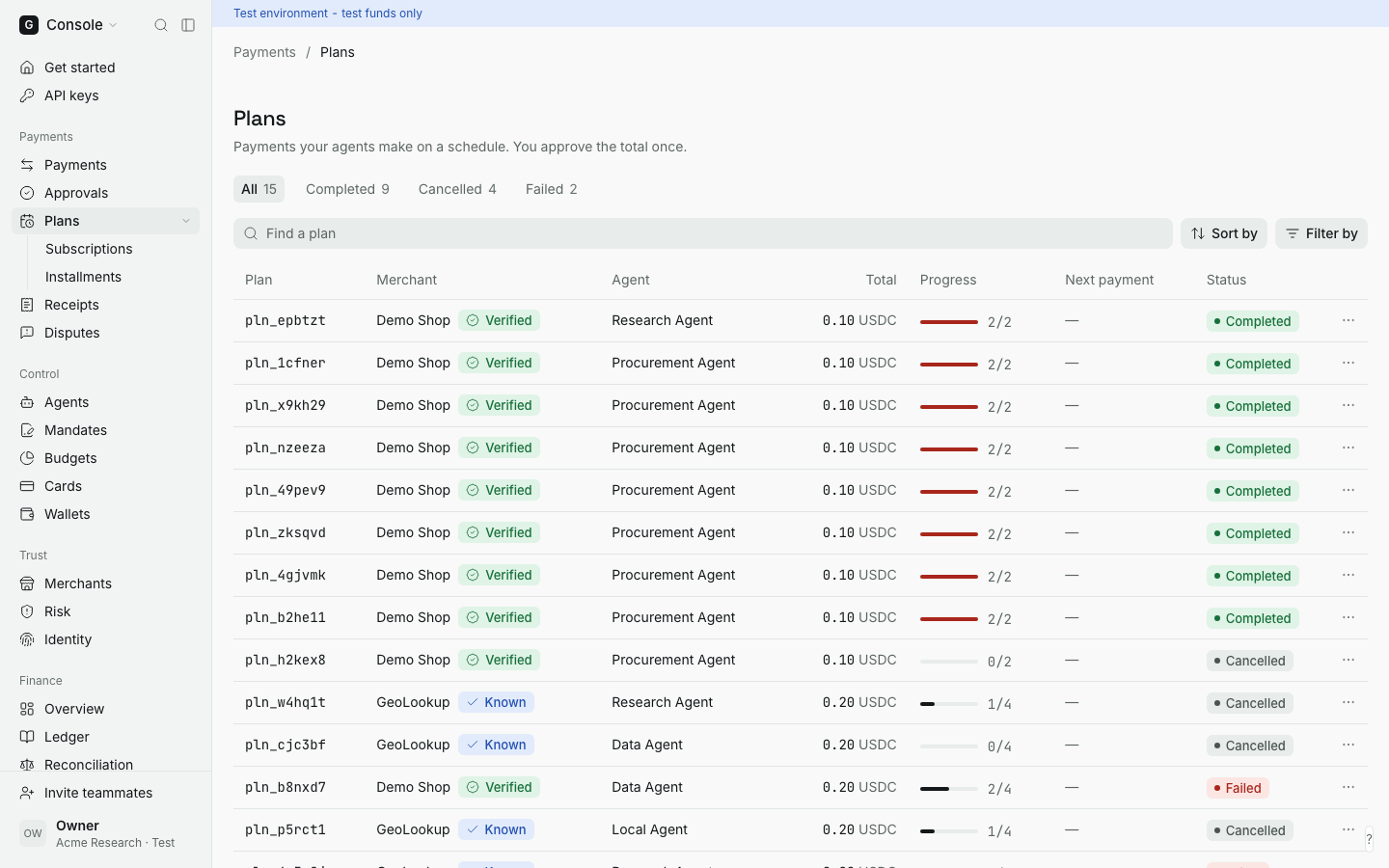
A durable schedule pulls each payment when it is due. Each pull is booked like a payment: budget, ledger, settlement and an installment receipt. An extra pull beyond what the delegation allows is rejected on chain.
Cancelling
Cancelling is one action in the Console. Abazi skips the remaining payments, releases the held budget and revokes the on-chain delegation; what is left in the plan account goes back to the owner. Abazi's signer cannot revoke the delegation on its own behalf, and it cannot pull after it is revoked.
What the merchant sees
The merchant console lists each plan with its active and total subscribers. A subscriber appears as an agent of the paying organization; agent ids, approval ids and payment ids are not shown.
Failure cases
| Situation | Result |
|---|---|
| The plan total is above the plan hard cap | Denied with HARD_CAP_EXCEEDED. |
| Nobody approves in time | Denied with APPROVAL_EXPIRED. |
| A pull fails | It is tried once more one period later. A second failure marks the plan failed, skips the rest, releases the budget and tells the owner. |
| The owner cancels | Remaining payments are skipped; unpulled funds return to the owner. |
| From | Can move to |
|---|---|
| pending_approval | active, cancelled |
| active | completed, cancelled, failed |
Next steps
Pay with a virtual card
Give an agent its own virtual card and see how each authorization is decided by the same policy, without the card number ever reaching the agent.
Split a payment
Set a split rule on a platform so each confirmed agent payment is shared between the platform and its merchants in fixed proportions, with one ledger entry and a payout receipt.