Pay with a virtual card
Give an agent its own virtual card and see how each authorization is decided by the same policy, without the card number ever reaching the agent.
What you end up with
An agent that can buy from a card-only merchant. The merchant sees an ordinary card payment from a virtual card. The owner sees the authorization, its decision and a receipt, and any attempt to use the card outside Abazi is declined and reported.
Before you start
The agent's mandate must allow the card rail and set a card hard cap. In the example mandate the card limits are 25.00 USD per authorization and 5.00 USD before a person must approve. Card limits are in US dollars.
Steps
Issue a card for the agent
In the Console, open Cards and issue a card for the agent. Abazi issues a virtual card with Lithic, with a per-transaction spending limit. An agent has at most one open card; asking again returns the same card. Abazi stores only a token and the last four digits.
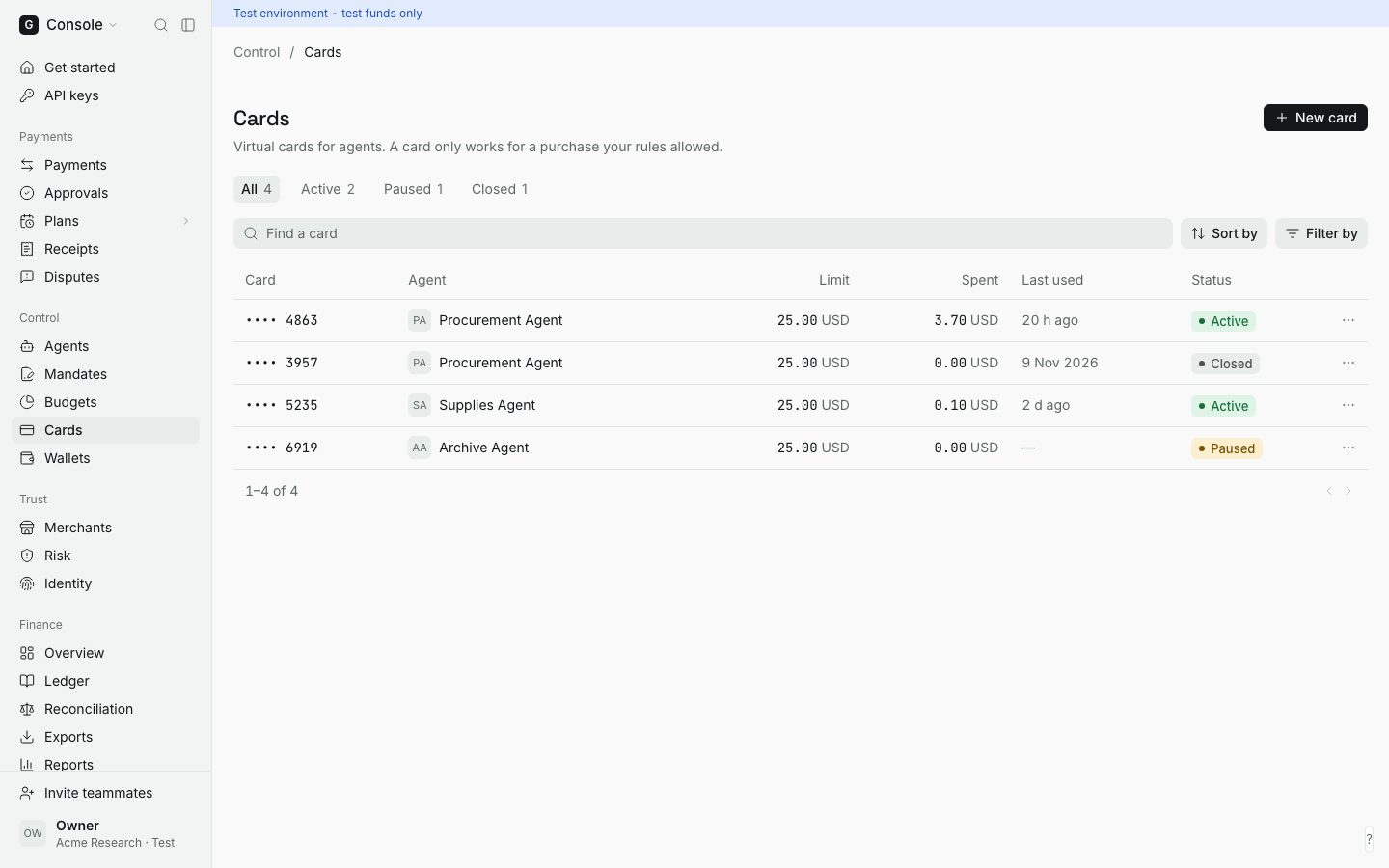
The agent asks to buy
The agent calls request_purchase for a card service in the Catalog, exactly as it would for a stablecoin service. The policy runs with the card limits: above the card hard cap it is denied, above the card auto-approve limit it needs a person.
Abazi pays at the checkout
On ALLOW, the amount is reserved. The signer fetches the card number from the card processor at that moment and sends it, server to server, to the merchant's checkout. The number is never stored, never logged and never handed to the agent.
The card network asks Abazi
The merchant authorizes the card. The card processor sends the authorization to Abazi in a signed request and waits for an answer. Abazi approves only if it finds a matching purchase: same agent, same amount, already reserved, within the last ten minutes.
| What Abazi finds | Answer |
|---|---|
| A reserved purchase with the same amount | Approve |
| A purchase of the same amount that is still waiting for a person | Challenge: the authorization is declined for now and tried again after approval |
| A purchase with a different amount | Decline, CARD_AMOUNT_MISMATCH |
| No purchase at all | Decline, CARD_NO_MATCHING_INTENT, plus a risk event and a notice to the owners |
Clearing and the receipt
When the card processor clears the authorization, the payment is confirmed: the reservation commits, the ledger posts and a receipt is issued. A voided authorization fails the payment and releases the reservation.
Above the auto-approve limit
A card purchase above 5.00 USD runs the checkout once while it waits for approval. Abazi answers that authorization with a challenge, so the card processor declines it. After a person approves, the checkout runs again and the new authorization finds a reserved purchase and is approved.
Refunds
A refund on a card payment is sent as a card return. It is booked like any refund: the budget is credited, the ledger posts and a refund receipt is issued. The payment counts as refunded once the full amount is returned.
Failure cases
| Situation | Result |
|---|---|
| The mandate does not allow the card rail | Denied with RAIL_NOT_ALLOWED. |
| The amount is above the card hard cap | Denied with HARD_CAP_EXCEEDED. |
| Someone uses the card number outside Abazi | Declined with CARD_NO_MATCHING_INTENT; the owners are told. |
| The owner pauses all payments | Every authorization is declined. |
Next steps
Approve a purchase on a phone
What an approver sees when an agent's purchase needs a person, how the one-time link and the passkey work, and what the agent sees before and after.
Sell on a plan
Publish an installment or subscription plan as a verified merchant, have an agent request it, and see the owner approve all the terms once while each pull stays capped on chain.