Custody and keys
Where the money sits on each network, who holds which key, which part of Abazi may sign, and how the owner withdraws Abazi's permission.
Who needs it
Owners, who want to know exactly what Abazi can do with their money. Security reviewers, who need to know where every key lives.
Who holds what
| Holder | Holds | Can do | Cannot do |
|---|---|---|---|
| Agent | An Abazi agent credential, shown once and stored only as a hash | Search, request purchases, read its own payments, receipts and budget | Sign, move funds, approve, change rules, see keys or card numbers |
| Owner | Their Solana wallet and their passkeys | Connect the wallet, grant and remove the spending permission, sign mandates, approve, sweep spending wallets | |
| Signer | The keys Abazi uses to pay, inside one isolated module | Sign a payment after rechecking the decision | Sign without an ALLOW decision, a held reservation and a matching fingerprint |
| Wallet service | The seed for per-agent spending wallets on EVM networks and Tron, built on Tether WDK, in a separate process | Sign direct USDT transfers, receipt anchors and attestations | Accept requests from other machines by default |
| Card issuer | The card numbers, at Lithic | Authorize card payments that Abazi approves |
Only the signer module loads signing keys. Every other part of Abazi sees addresses and signatures, not keys. The language model behind an agent never sees a key either: none of the agent's tools takes a key, a price or a payout address, and none returns a key or a card number.
Where the money sits
| Network | Pays from | What Abazi can spend |
|---|---|---|
| Solana (USDC over x402) | The owner's own USDC account. The owner signs an SPL token approval that makes Abazi's signer a delegate of that account. | Up to the cap the owner set, which cannot exceed the organization budget. The owner removes the permission in their wallet at any time. |
| Base, Polygon, Avalanche (USDC over x402) | A per-agent spending wallet held by the signer. It signs an EIP-3009 transfer authorization, so it needs USDC but no gas. | What the owner funded it with. The owner can sweep it back. |
| Ethereum, Tron (direct USDT) | A per-agent spending wallet built on Tether WDK, held by the wallet service. It pays gas in ETH or TRX. | What the owner funded it with. The owner can sweep it back. |
| Virtual card | A card per agent, issued by Lithic. | Each authorization, decided by Abazi's policy. |
This is the custody design, network by network:
- Solana is non-custodial. The owner's USDC never leaves the owner's account until a payment, and the signer can spend only the delegated amount.
- EVM networks and Tron use capped spending wallets. Abazi's signer holds the key to each agent's wallet. The owner decides how much goes in, sees the balance in the Console, and sweeps it back at any time. An agent can never spend more than its wallet holds, and its mandate and budgets still apply to every payment.
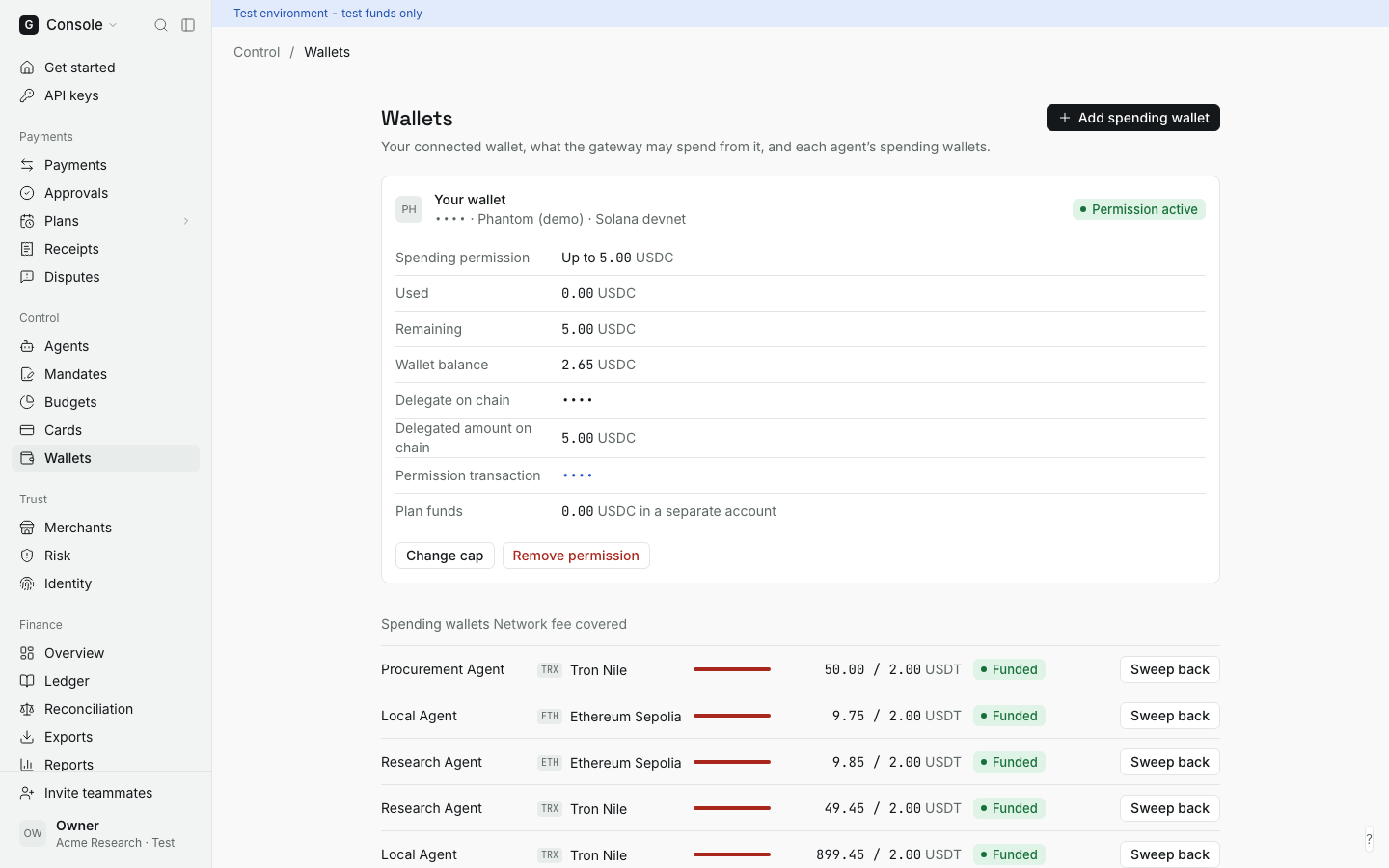
The full list of wallets, owner-connected and provisioned, is on Wallets.
Card numbers
Card numbers never reach the agent. When an agent buys with its virtual card, the signer requests the card details from the card issuer and posts them server to server to the merchant's checkout. They are not logged or stored, and the merchant's authorization comes back to Abazi's policy to be approved or declined. See Cards.
Boundary
- Delegation is one permission per account. An SPL token account has one delegate. That is why each installment plan funds its own owner-owned plan account. See Installments and subscriptions.
- Removing the permission stops Solana at once. Payments that would need it are denied with DELEGATION_MISSING. Other networks are not affected.
- Sweeping a spending wallet stops that network. With an empty wallet, the network is skipped at selection and the next allowed, funded network is tried.
- Revoking an agent cuts every path. Its credential stops working, purchases it had reserved are denied, its card is closed and its plans are cancelled. The owner is prompted to remove the on-chain permission too.
Example
An owner with a funded Solana account and one agent:
Failure cases
| Case | Result |
|---|---|
| No permission, or it is used up | DENY DELEGATION_MISSING on Solana. |
| The spending wallet is empty on every allowed network | DENY NO_FUNDED_CHAIN. |
| The purchase changed between decision and signing | The signer refuses to sign (APPROVAL_INVALIDATED). |
| Payments are paused | The signer refuses to sign (KILL_SWITCH_ACTIVE). |
How to verify
- The Console's wallets page shows the connected wallet, the permission's cap and remaining amount, and each agent's spending wallets with their balances.
- The permission is an ordinary SPL token approval: any Solana explorer shows the delegate and the amount on the owner's account.
Next steps
Merchant trust tiers
How a merchant becomes UNKNOWN, KNOWN or VERIFIED, what each tier changes for an agent's purchases, and what resets a merchant back to UNKNOWN.
Rails and networks
Why one mandate spans stablecoins and cards, how networks are named, and how Abazi picks one network for each payment from the mandate's order, funds and facilitator health.